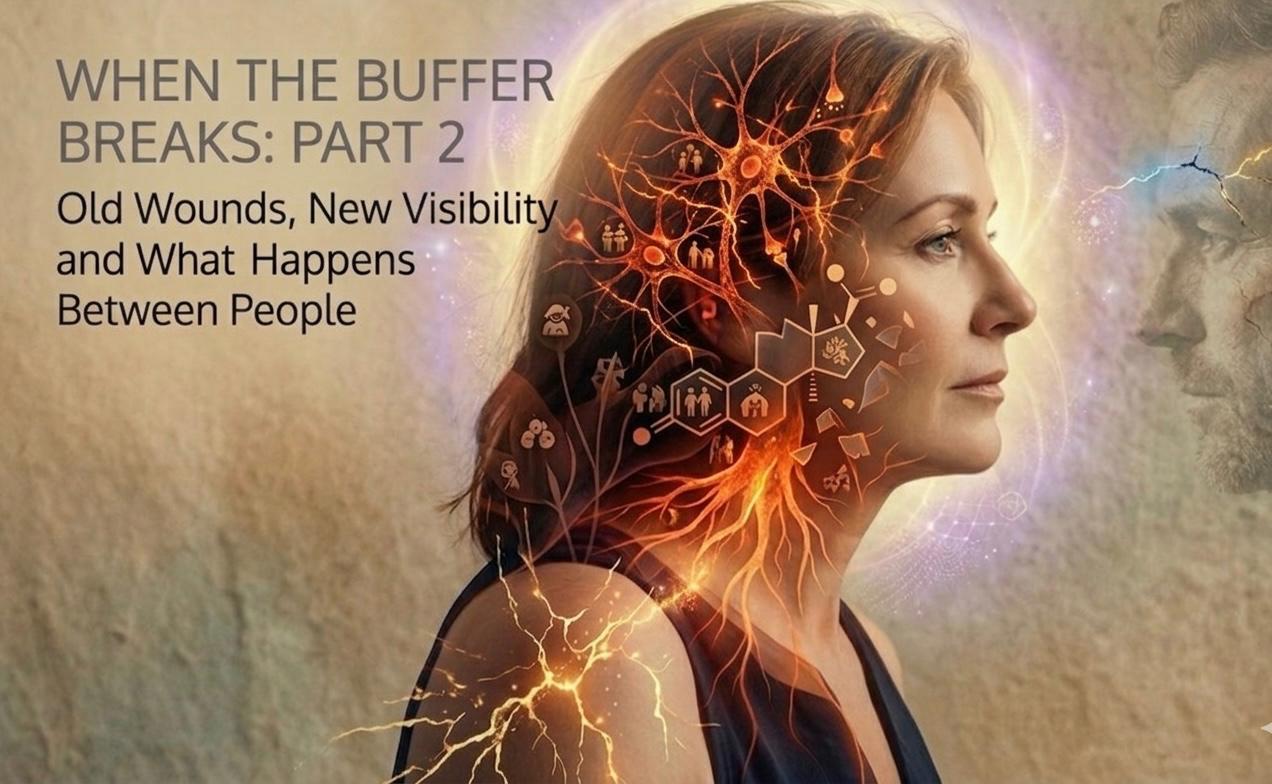
Part 2 of 5 — Old Wounds, New Visibility — and What Happens Between People
This is the second in a five-part series on menopause, the nervous system, and what the body has been waiting to tell us. If you missed Part 1, it is available on the blog.
One of the most significant shifts in how researchers now understand menopause is also one of the most quietly radical: the transition does not create new psychological difficulties. It reveals what was already there — stress patterns, trauma imprints, and nervous system dysregulation that the body was managing, biochemically, all along.
This changes the entire picture.
If menopause were simply causing new symptoms, the task would be to treat those symptoms. Suppress the hot flashes, stabilise the mood, restore the sleep and return to normal. But if menopause is unmasking what was always present, dissolving the chemical buffer that kept certain truths below the threshold of awareness, then the task is something entirely different. It is to listen to what is surfacing, not silence it.
The research is unambiguous on this point. A long-term study that followed 243 women over sixteen years found that those who had experienced two or more significant childhood adversities had more than double the risk of experiencing major depression for the first time during the menopausal transition. The researchers were explicit: the hormonal shift of perimenopause appears to unmask vulnerability that had been neurochemically compensated.
A separate study of over 1,600 women found a striking pattern: the more childhood adversity a woman had experienced, the more severe her menopausal symptoms. Women with four or more adverse childhood events had nearly ten times the likelihood of being in the most severe symptom category compared to women with none. This was not a localised effect confined to mood. It showed up across every domain, physical, psychological, and hormonal.
What does this mean in practice? The panic attack arriving for the first time at forty-seven is not new pathology. It is an old wound, held in chemical suspension, finally surfacing through a nervous system that can no longer filter it out. The sudden intolerance for dynamics that were always unjust or exhausting is not hormonal irrationality. It is the nervous system finally accurately registering, perhaps for the first time, what it was previously buffered against perceiving.
When the Buffer Breaks Between Two People
Perhaps the least-discussed dimension of this transition is what it does inside relationships.
Research has shown something remarkable: the stress responses of people who live closely together become physiologically linked over time. When one partner’s nervous system is activated, the other’s stress hormones rise in response, like a biological call and answer. In couples who are thriving, this can be a source of mutual calm. In couples who are already struggling, it amplifies rather than soothes: one person’s dysregulation triggers the other’s unresolved patterns, and the feedback loop escalates.
When a woman’s neurochemical buffer dissolves, she loses the biological basis for accommodating, peacemaking and absorbing dynamics that were always costly. The neurological incentive to keep this peace weakens with the hormonal changes of menapause. Issues that were always present become intolerable. What looks like sudden irritability from the outside is often the nervous system finally refusing to absorb what it was never actually okay with.
Researchers now use the term “couplepause” to acknowledge that when one partner’s nervous system is fundamentally reorganising
Researchers now use the term “couplepause” to acknowledge that when one partner’s nervous system is fundamentally reorganising, the other is drawn into that reorganisation whether they choose to be or not. A large survey found that nearly three-quarters of divorced women cited menopause as a contributing factor. The average age of divorce aligns precisely with the years of perimenopause. These are not numbers about hormones making women irrational. They are evidence of truth becoming unsuppressible.
But destruction is not the only possible outcome. Research consistently shows that women in emotionally present, stable relationships experience significantly milder menopausal symptoms. When a man learns to approach his partner’s reactivity as signal rather than attack and when he can begin to ask what that reactivity triggers in his own nervous system, the transition becomes something navigated together. Often, it deepens the bond rather than dissolving it.
At the root of most relational rupture, during this period of life, are due to the asking of fundamental questions: Am I seen here? Do I matter? Is it safe to be fully myself? Menopause brings those questions to the surface with an urgency that can no longer be postponed.
Part 3 of this series explores the male experience of midlife hormonal shift
Part 3 of this series explores the male experience of midlife hormonal shift — why it tends to be quieter, and why that very quietness may be its greatest risk. We then move into something that may surprise you: what older wisdom traditions across the world understood about this threshold long before neuroscience existed to confirm it.
Blessings
Amanda
Website | Instagram | Facebook
Part 1: When The Buffer Breaks: Part 1 -The Shock Absorber
Part 3: When The Buffer Breaks: Part 3 – The Quiet Reckoning
Part 4: When The Buffer Breaks: Part 4 – Working With What Is Surfacing
Part 5: When The Buffer Breaks: Part 5 – The Body Is Not Lying