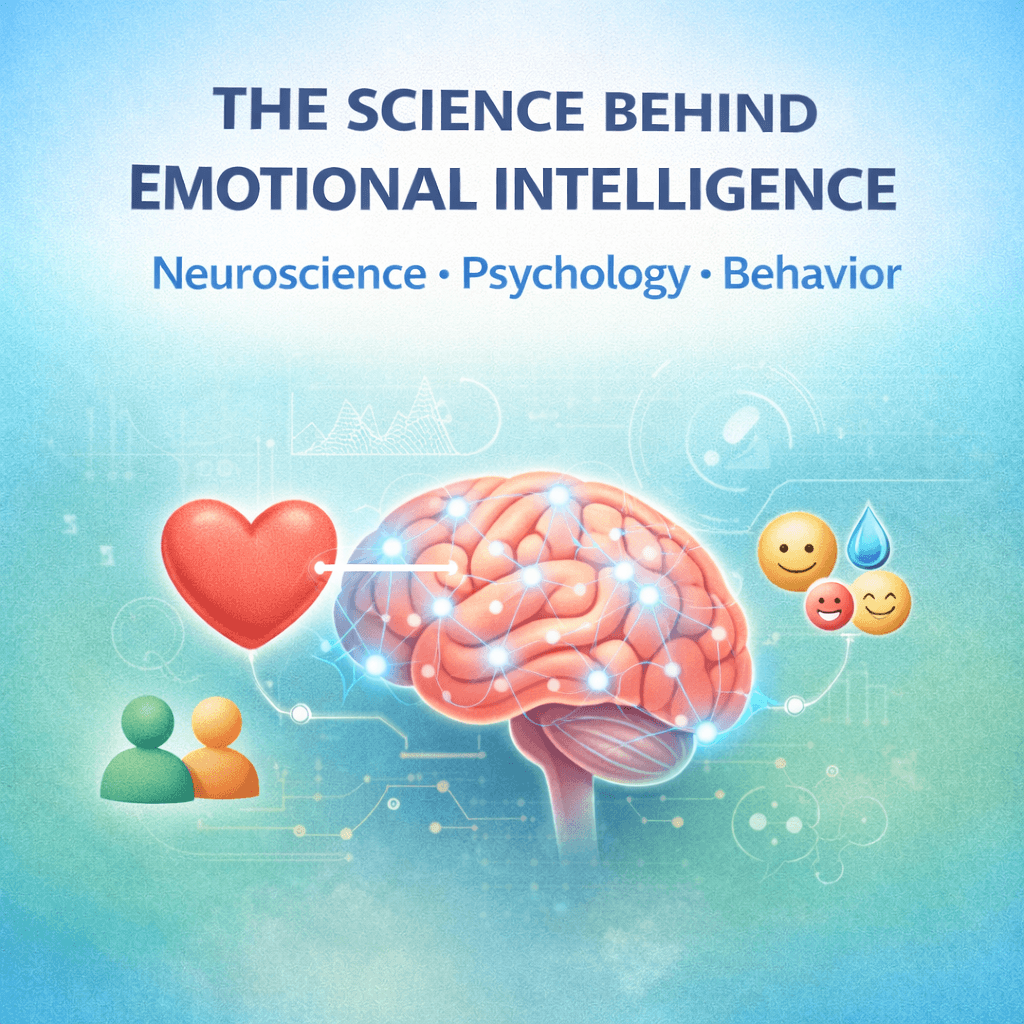
What is the science behind emotional intelligence?
The science behind emotional intelligence explains how humans recognise, understand, and manage emotions using both psychological processes and brain-based systems. Emotional intelligence involves perceiving emotions, using them to guide thinking, understanding emotional patterns, and regulating responses in everyday life.
Most people think emotions are random or something they just have to deal with. But science shows that emotions follow patterns. They influence how we think, how we react, and how we connect with others.
When you understand what is happening underneath your emotions, things start to feel less confusing. You gain more control, more clarity, and more confidence in how you respond to life.
How emotional intelligence works scientifically
Research shows that emotional intelligence is not a single trait. It is a group of abilities that work together. These include recognising emotions, understanding what they mean, and managing how you respond.
Scientists describe emotional intelligence as a form of social intelligence that helps people monitor their own emotions and the emotions of others, then use that information to guide decisions and behaviour.
This means emotional intelligence is not about ignoring emotions. It is about using them in a way that improves thinking, relationships, and daily choices.
The Science Behind Emotional Intelligence
Emotional intelligence is often discussed in personal growth, leadership, education, and wellbeing. But it is also a subject that has been studied in psychology, workplace research, and emotional development theory for decades.
This page gives a clear beginner-friendly overview of the research, models, and ideas that have shaped how emotional intelligence is understood today.
What Researchers Mean by Emotional Intelligence
Emotional intelligence generally refers to the ability to recognize, understand, use, and manage emotions in ways that support thinking, communication, relationships, and decision-making.
Over time, researchers have approached emotional intelligence in different ways. Some focus on emotional intelligence as a set of abilities, others describe it as emotional self-perception or personality-related tendencies, and others connect it to broader emotional and social competencies used in daily life and work.
This is one reason emotional intelligence is both widely used and widely debated: it is not based on only one single model.
Daniel Goleman’s Contribution
Daniel Goleman helped bring emotional intelligence into mainstream public awareness. His work made the topic far more visible in education, leadership, business, and personal development.
Goleman’s framework is often associated with practical emotional competencies such as self-awareness, self-regulation, motivation, empathy, and social skills. Because of this, his approach has been especially influential in workplace and leadership discussions.
Goleman’s work did not create the original academic concept of emotional intelligence, but it played a major role in helping people understand why emotional skills matter beyond IQ, grades, or technical ability alone.
For many readers, Goleman’s work is the starting point that makes the research more accessible and more practical.
Major Emotional Intelligence Models
Emotional intelligence research is often grouped into a few major models. Understanding these models helps explain why different articles, books, and assessments sometimes define emotional intelligence in different ways.
1. Ability Model
The ability model is most strongly linked to researchers such as Peter Salovey, John Mayer, and David Caruso. This model treats emotional intelligence as a form of intelligence involving emotional reasoning. It focuses on abilities such as perceiving emotions, using emotions to support thinking, understanding emotional meaning, and managing emotions effectively.
2. Trait Model
Trait emotional intelligence is often associated with K. V. Petrides. This approach focuses more on emotional self-perceptions and personality-related tendencies. It looks at how people view their emotional abilities, confidence, and everyday emotional functioning.
3. Mixed or Competency Models
Mixed models combine emotional abilities with broader competencies, behaviors, and interpersonal effectiveness. These models are often used in leadership, coaching, and workplace development because they connect emotional intelligence to real-world performance and communication.
What Psychology Research Has Explored
Psychology research on emotional intelligence has explored many different questions, including:
- How emotional intelligence should be defined
- How it can be measured
- Whether it predicts wellbeing, relationships, or stress management
- How it relates to personality and cognitive ability
- Whether it contributes to leadership, teamwork, and job performance
- How it can be developed through learning, reflection, and training
Researchers have also spent significant time examining emotional intelligence measurement tools, because the value of any theory depends heavily on whether it can be measured clearly and consistently.
This is why emotional intelligence research includes not only theory, but also debates about assessments, definitions, and practical application.
Emotional Intelligence in the Workplace
Workplace research has helped make emotional intelligence especially important in professional settings.
Studies and reviews often explore how emotional intelligence relates to communication, leadership, teamwork, conflict management, job satisfaction, organizational commitment, and performance.
Emotional intelligence is often discussed in workplaces because technical skills alone do not explain how people handle pressure, feedback, interpersonal tension, or emotionally demanding situations.
In practical terms, emotional intelligence can affect how people:
Respond to stress
Staying aware and composed under pressure can improve judgment and communication.
Work with others
Empathy, listening, and emotional regulation can strengthen teamwork and trust.
Handle conflict
Emotionally aware responses can reduce escalation and support healthier problem-solving.
Lead effectively
Leaders often need both emotional insight and interpersonal balance to guide teams well.
Because of this, emotional intelligence is regularly included in workplace training, coaching, professional development, and leadership conversations.
Why This Research Matters
The research behind emotional intelligence matters because it moves the conversation beyond vague self-help language. It helps people understand that emotional skills can be studied, discussed, measured, and applied in meaningful ways.
It also shows that emotional intelligence is not just about being “nice” or “calm.” It involves awareness, interpretation, regulation, communication, and emotional understanding in real situations.
For a website like Emotional Intelligence Developer, this kind of page adds educational depth and shows visitors that emotional growth is connected to real research, not only personal opinion.
A Balanced View
Emotional intelligence is widely respected, but researchers do not agree on every detail.
Some debates continue around definitions, overlap with personality, measurement methods, and how much emotional intelligence adds beyond other well-known traits or abilities. That makes this field interesting, active, and still developing.
Explore Emotional Intelligence in Practice
Research is valuable, but emotional intelligence also becomes meaningful when people can reflect, practice, and apply it in daily life.
If you want to go beyond theory, you can explore the practical tools and guided resources available on Emotional Intelligence Developer.
Key Topics Covered on This Page
Daniel Goleman research, emotional intelligence psychology studies, EQ models, emotional intelligence in the workplace, emotional intelligence theory, and emotional intelligence measurement.
Core components of emotional intelligence
- Self-awareness: Recognising your own emotions and how they affect your behaviour.
- Self-regulation: Managing emotional reactions instead of reacting impulsively.
- Empathy: Understanding how others feel and responding appropriately.
- Social awareness: Reading emotional cues in conversations and environments.
- Decision-making: Using emotions to guide better choices.
These skills work together to help people communicate more effectively, manage stress, and build stronger relationships.
Further Reading: Emotional Intelligence Books
Many people first discover emotional intelligence through books written by psychologists and researchers. One of the most influential works is Emotional Intelligence: Why It Can Matter More Than IQ by psychologist and science journalist Daniel Goleman. The book helped bring emotional intelligence research into public awareness and showed how emotional skills influence success, relationships, decision-making, and leadership.
If you would like to explore the research and ideas behind emotional intelligence in more depth, you can browse the recommended books below.
These books explore topics such as emotional awareness, empathy, leadership psychology, and how emotional intelligence can influence both personal wellbeing and professional success.
Explore more emotional intelligence resources
Next step
Understanding the science is helpful. But real change happens when you apply it. Start with one tool, one reflection, or one small step today.
Explore Emotional Intelligence ToolsFrequently Asked Questions
Is emotional intelligence scientifically proven?
Yes. Research shows that emotional intelligence involves measurable skills such as recognising, understanding, and managing emotions.
Can emotional intelligence be developed?
Yes. Studies show that emotional intelligence is a set of skills that can be learned and improved over time.
What part of the brain controls emotional intelligence?
Emotional intelligence involves brain systems linked to emotion processing, decision-making, and social understanding.
Why is emotional intelligence important in daily life?
It helps people manage stress, communicate better, make clearer decisions, and build stronger relationships.
Is emotional intelligence more important than IQ?
Both are important. Emotional intelligence supports how you manage yourself and interact with others, while IQ focuses more on cognitive ability.